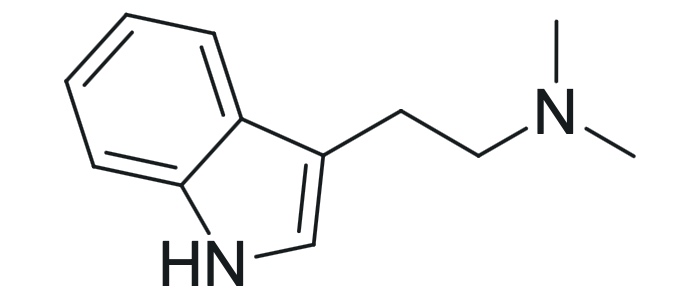
Ayahuasca
Ayahuasca is an orally administered mixture of a DMT-containing plant (usually Psychotria Viridis/Chakruna, but also Diplopterys Cabrerana/Yagé or Mimosa Hostilis/Jurema) and Banisteriopsis Caapi, an MAO inhibitor that is supposed to slow down the metabolism of DMT. The raw materials are legal in Germany, but any processing is prohibited, including of ayahuasca.
Ayahuasca originates from the Amazon region where it is the most common mind-expanding substance, although it is only used in a ritual context. It is regarded as having a feminine spirit and is often referred to as ‘the grandmother’. In Peru, it is part of the national cultural heritage.
Ayahuasca can trigger strong hallucinations, but is also suitable for therapeutic use. Its special features are that it has a strong healing effect on the body and its neuroplastogenic effect stimulates nerve growth and the formation of new nerve connections. It tastes very unpleasant and often leads to nausea and vomiting. Its effects last around three hours, but in a traditional context, several doses are given so that the total duration of a session can be expanded.
Ayahuasca should not be confused with 5-MeO-DMT, which also contains DMT and only works for around 50 minutes.
In Switzerland, attempts are underway to replace ayahuasca with synthetic DMT.